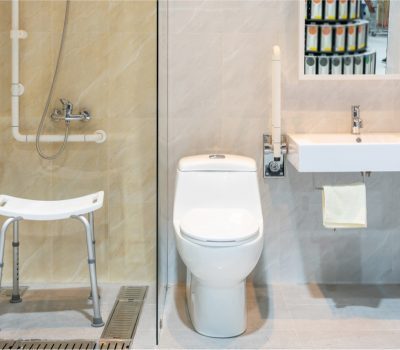
Short answer: In the UK, disabled toilets are now usually called accessible toilets. You will also see wheelchair accessible toilet, unisex accessible toilet, ambulant cubicle and Changing Places toilet, which describe specific types. "Disabled toilet" is still widely understood and used, but most organisations prefer "accessible", which describes the facility rather than the person.
Names on toilet doors have changed a lot over the last few decades. Older signs said "disabled" or even "invalid", while American sources still use "handicap". Today you are more likely to see "accessible toilet", often alongside a sign that says not every disability is visible.
This guide sets out the names you will come across in Scotland and the rest of the UK, what each one actually means, and why the language has shifted.
The term most used today: accessible toilet
"Accessible toilet" is now the standard term in the UK. It is used by councils, transport operators, shops, hospitals and most building guidance. It describes a toilet designed so that disabled people can use it, with enough space to move around, grab rails, a seat at a suitable height and an alarm to call for help.
"Disabled toilet" has not disappeared. It is still the phrase many people use in conversation, and it is not generally considered offensive. If you are writing a sign, a policy or a website, though, "accessible toilet" is the safer and clearer choice. If you are wondering whether these are all the same facility under different names, our guide to whether an accessible toilet is the same as a handicap toilet answers that in detail.
Current names and what they mean
Several names are in use because there are different kinds of accessible toilet. Each one is designed for a different group of people.
| Name | What it describes |
|---|---|
| Accessible toilet | The general term for a toilet designed for disabled people. Usually a separate room with space, rails and an alarm. |
| Wheelchair accessible toilet | A more precise name for a room with enough space for a wheelchair user to turn and transfer to the toilet. |
| Unisex accessible toilet | An accessible toilet that anyone can use regardless of sex, so a carer of any gender can help. Scottish guidance asks for at least one unisex accessible toilet where toilets are provided. |
| Ambulant cubicle | A cubicle within a standard toilet block with grab rails, for people who can walk but need support to sit down and stand up. Not sized for wheelchairs. |
| Changing Places toilet | A larger room with a ceiling track hoist, an adult changing bench and space for up to two assistants. |
| Disabled toilet | The older everyday name. Still widely understood. |
Wheelchair accessible toilets
These are the rooms most people picture when they think of a disabled toilet. In Scotland, guidance for non-domestic buildings asks for a clear manoeuvring space of at least 1.5m by 1.5m, kept clear of the door swing, plus a WC seat at 480mm, fixed and folding grab rails, and an assistance alarm that can be operated from the floor.
Ambulant cubicles
Many people who need a little support do not use a wheelchair. Ambulant cubicles help people who use sticks, crutches or a walking frame, or who have joint pain or balance problems. They are wider than a standard cubicle and have rails on both sides.
Changing Places toilets
Changing Places toilets are for people with profound and multiple learning disabilities and others who need significant help, including many people who cannot use a standard accessible toilet at all. Since regulations introduced in 2020, they are required in certain new large buildings in Scotland, such as large shops and venues, buildings with a swimming pool, hospitals and some secondary schools. In England, the rules changed for certain new large buildings from 1 January 2021. They are provided in addition to standard accessible toilets, not as a replacement.
Why the language changed
The move from "disabled" or "handicap" to "accessible" reflects a wider shift in how disability is understood in the UK.
Focusing on the building, not the person
Under what is known as the social model of disability, people are disabled by barriers in the world around them, such as steps, narrow doors or toilets they cannot reach, rather than by their condition alone. Calling a toilet "accessible" puts the focus on whether the facility removes those barriers.
Including people with hidden conditions
"Disabled toilet" and the wheelchair symbol can give the impression that only wheelchair users are welcome. In reality, accessible toilets are needed by people with bowel and bladder conditions, people with a stoma, people living with pain or fatigue, people with sensory impairments and many others. A broader name helps make that clear.
Moving away from outdated words
Words such as "handicapped" and "invalid" are now widely seen as outdated in the UK. For more on respectful wording, including how to describe a bathroom at home, see our guide to the politically correct term for a handicap bathroom.
Signs you will see on accessible toilets
Signage has changed along with the names.
- The wheelchair symbol. Still the most common sign, and still widely recognised, even though the toilet is for a wider group of people.
- "Not every disability is visible". Many accessible toilets now carry this message, following a campaign by Crohn's and Colitis UK. It reminds people not to judge someone who walks out of an accessible toilet without an obvious impairment.
- Changing Places signs. These mark the larger rooms with a hoist and changing bench, so people who need them can find them quickly.
- National Key Scheme locks. Some accessible toilets are locked to stop misuse. They open with a National Key Scheme key, often called a RADAR key, which is run by Disability Rights UK and gives independent access to over 9,000 locked toilets across the UK.
The "not every disability is visible" message also answers a question many people have: who is actually allowed to use these toilets? We look at that in our guide on whether non-disabled people can use accessible toilets.
Does the name really matter?
For most people the important thing is that the toilet is there, it is clean, and it works. But names do matter in practical ways:
- Clear, accurate signs help people find the right facility quickly, which matters a great deal if someone has an urgent need.
- Using "accessible" rather than "disabled" helps people with hidden conditions feel they have every right to use the toilet.
- Knowing the difference between an accessible toilet, an ambulant cubicle and a Changing Places toilet helps venues provide the right mix of facilities.
What we call accessible bathrooms at home
At home, the same shift in language applies. You will hear people talk about an accessible bathroom, a mobility bathroom, an adapted bathroom, a wet room or a level access shower room. These all describe a bathroom set up so that someone with reduced mobility can use it safely and with dignity.
Modern accessible bathrooms rarely look clinical. Grab rails, raised toilets, level access showers and fold away shower seats now come in finishes that sit comfortably in a stylish room. If you would like to see what is possible, take a look at our overview of disabled bathrooms, or read our explainer on what a mobility bathroom is.
Making the bathroom at home easier to use? We offer a free 3D design and a no-obligation quote, with all the work carried out by our own team. Send us a message to get started.
Frequently asked questions
Is it wrong to say disabled toilet?
No, it is still widely used and understood. "Accessible toilet" is the term most organisations now prefer because it describes the facility and includes people with hidden conditions.
What is an ambulant toilet?
An ambulant cubicle is a toilet cubicle within a standard block, fitted with grab rails, for people who can walk but need support. It is not designed for wheelchair users.
What does a Changing Places sign mean?
It marks a larger accessible toilet with a ceiling hoist, an adult changing bench and room for up to two assistants, for people who cannot use a standard accessible toilet.
What is a RADAR key?
It is the common name for a National Key Scheme key, run by Disability Rights UK. It opens over 9,000 locked accessible toilets across the UK and is sold to people who need the facilities because of a disability or health condition.