Short answer: An easy access bath is any bath set up so an older person can get in and out safely. The main options are walk-in baths with a side door, baths with lower sides, bath lifts that lower you into the water, and bath boards or seats. If stepping over any rim is too hard, a level access shower is usually safer.
Many older people love a bath and do not want to give it up. The trouble usually starts with the side of the bath: stepping over it, lowering yourself to the bottom and getting back up again all take strength and balance. An easy access bath is not one single product. It is a range of solutions that make bathing possible again, from a simple seat to a full replacement bath.
This guide compares the main options, explains who each one suits, and covers when a shower is the better choice.
The main types of easy access bath
Walk-in baths
A walk-in bath has a watertight door built into its side. You step over a low threshold, sit on a built-in seat at roughly chair height, close the door, and fill the bath around you. Once you are finished, it drains before the door opens. Many models offer a powered lift seat, spa jets or a heated seat. Our guide to how mobility walk-in baths work explains filling, draining and door seals in detail.
Low sided and easy access baths
Some baths are made with a lower rim, a flatter base or a wider entry point, so stepping in is easier than with a standard bath. They look like an ordinary bath and suit someone whose mobility is only slightly reduced. They still involve stepping over a side and sitting down low, so they help less as mobility declines.
Bath lifts
A bath lift is a seat that sits inside your existing bath and lowers you into the water, then raises you back up, usually powered by a rechargeable battery. You sit on the lift at the rim, swing your legs over, and press a button. Bath lifts can be a good, lower cost way to keep using a bath you already have, but you still need to lift your legs over the side.
Bath boards and bath seats
A bath board rests across the top of the bath. You sit on it from outside, swing your legs in, and wash sitting on the board, often with a hand shower. A bath seat hangs a little lower inside the bath. These are simple pieces of equipment, and in Scotland they are usually assessed for and provided through your local Health and Social Care Partnership, sometimes on free loan.
Shower baths
A shower bath is wider at one end to give more standing room under a shower. It suits a family bathroom where someone still wants a bath but also uses the shower. It is not truly easy access, because you still step over the full height of the side.
Options compared at a glance
| Option | How you get in | Best for | Main limitation |
|---|---|---|---|
| Walk-in bath | Through a side door with a low step | People who can walk a few steps and sit on a chair | You sit in the bath while it fills and drains |
| Low sided bath | Step over a lower rim | Slightly reduced mobility | Still involves sitting low in the bath |
| Bath lift | Sit at the rim, swing legs over, lift lowers you | People who struggle to sit down or stand up from the bath floor | You must lift your legs over the side |
| Bath board or seat | Sit from outside, swing legs in | A short term or low cost solution | No real soak; balance needed to swing legs over |
| Shower bath | Step over the full side | Family bathrooms | Not suitable if stepping over a rim is hard |
When a shower is the better answer
A bath is not always the safest choice, however it is adapted. A level access shower or wet room is often better when:
- you cannot lift your legs over any rim or step, even a low one;
- you use a wheelchair and need to transfer onto a shower chair;
- a carer helps you wash and needs space to stand beside you;
- your condition is likely to change, so you need a room that adapts with you;
- you feel dizzy or unwell after sitting in warm water.
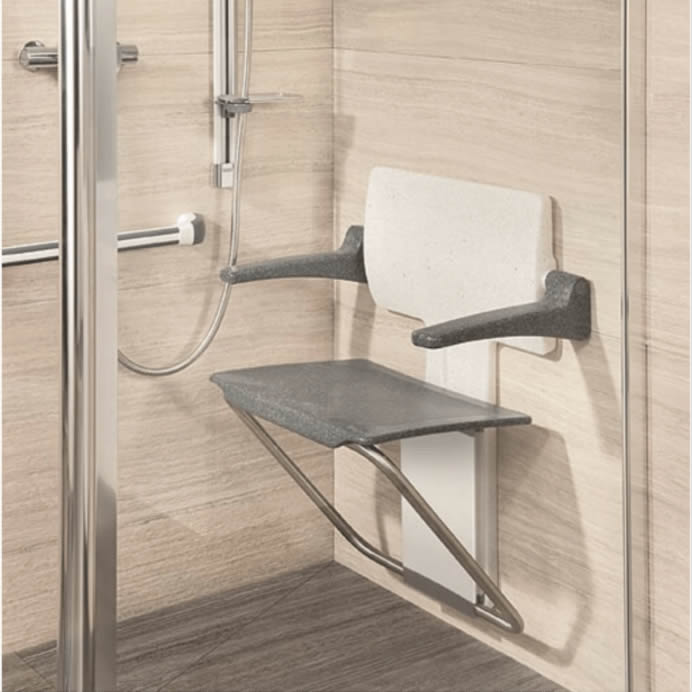
A walk-in shower with a fold down seat, grab rails and a hand shower gives a safe, seated wash with no step at all. If you are weighing up the two, our article on overcoming mobility issues with a standard bath takes you through the decision, from small aids to replacing the bath entirely.
Safety features worth insisting on
Whichever option you choose, these features make bathing safer:
- Grab rails fixed securely into the wall, where you step in, sit and stand. Basins, towel rails and radiators are not built to take your weight.
- Thermostatic control so the water cannot come out scalding hot.
- Non-slip surfaces inside the bath and on the floor outside it.
- Controls within reach of where you sit, including the taps, plug and hand shower.
- Good lighting and colour contrast, so the edge of the bath and the rails are easy to see.
Simple fixtures like grab rails and seats are often the first step. You can see what is involved on our bathroom adaptations page.
Choosing the right option
Start with an assessment
An occupational therapist (OT) can assess how the person moves, what they can manage safely and what equipment or adaptation would help. In Scotland you can usually ask for an assessment through the council's social work service or your local Health and Social Care Partnership. Low priority cases may wait, so it is worth asking early. Please check with the GP or OT before choosing a bath if there are heart problems, low blood pressure or balance issues.
Think about the next few years
A bath lift might solve today's problem, but if mobility is likely to decline, a solution that copes with future needs can save a second round of work. Our guide on making a bathroom accessible for an older person covers quick wins and bigger changes side by side.
Check the space and the plumbing
Walk-in baths are deeper and hold more water, so the hot water system needs to keep up. Doors need room to swing open. A surveyor should check the room, the floor and the pipework before you commit.
Costs, VAT relief and grants in Scotland
Costs vary widely. Bath boards and seats are inexpensive and often provided through the Health and Social Care Partnership. Specialist suppliers typically quote around £6,000 to £12,000 or more for a walk-in bath supplied and installed, and from around £6,000 for a walk-in shower conversion. These are typical ranges, not quotes.
- 0% VAT can apply to adapting a bathroom for someone who is chronically sick or disabled, where the work is needed for their condition. It is not means tested, and you sign a declaration for the installer.
- 5% VAT applies for people aged 60 or over on bath lifts, grab rails, built-in shower seats and walk-in baths with sealable doors, when supplied and installed by the same installer.
- Scheme of Assistance: in Scotland, councils must give a grant of at least 80% of the eligible cost of adaptations needed to use a bath or shower, rising to 100% for people on certain benefits. The Disabled Facilities Grant applies in England, Wales and Northern Ireland, not here.
Eligibility rules are set by HMRC and your council, so check with them before relying on any relief. If a walk-in bath is the right fit, you can read more about our walk-in baths in Glasgow, which we supply and fit across Scotland with our own team.
Not sure whether a bath or shower would suit best? Our team can create a free 3D design of both options and give you a no-obligation quote. Request your free bathroom design.
Frequently asked questions
Is a bath lift or a walk-in bath better?
A bath lift costs less and uses your existing bath, but you still have to swing your legs over the side. A walk-in bath removes most of that step. If lifting your legs is already difficult, a walk-in bath or a level access shower is usually more suitable.
Can I get a bath board for free?
Often, yes. In Scotland, bath boards, bath seats and similar equipment are usually provided after an OT assessment through the Health and Social Care Partnership, sometimes on free loan. Contact your council's social work service to ask.
Are easy access baths only for older people?
No. They also help disabled people of any age and people recovering from surgery or an injury. Anyone who finds the side of a standard bath hard to manage may benefit.
Will removing the bath affect my home's value?
A well designed walk-in shower appeals to many buyers. Some buyers with young children prefer a bath, so if you have more than one bathroom, keeping a bath in one of them can help.